

In this article, learn how to use Archie to recall and summarise facts and information from Matter Details and documents.
Table of Contents
- Use Archie to ask questions about your matter
- How to write a good prompt for Archie
- Persona (Who should Archie act as?)
- Task (What do you want Archie to do?)
- Context (What information should Archie rely on?)
- Format (How should the final output be structured?)
- Example prompts using the Persona → Task → Context → Format structure
- Prompt cheatsheets
- Getting Archie's help
- Expectations and limitations when asking Archie
- Advanced tips for creating your prompts
- triConvey AI disclaimer
Use Archie to ask questions about your matter
Currently, you can ask Archie about the following data within a matter to generate contextual responses:
- Basic Matter Info: Matter number, title, status, matter type and category, description, date opened, date closed, key dates and staff
- Matter Parties: The contact and role details of all parties listed in the matter, such as clients, the other side, their solicitors, and related parties such as executors, agents or guarantors
- Archie cannot look up contacts in your firm's wider contact list.
- Archie cannot look up contacts in your firm's wider contact list.
- Tasks: Subject, due date, assignee and completion status
- Events: Title, date/time and attendees
- Memos and File Notes attached to the matter
- Invoices and trust/office account details
- Archie cannot access time/fee entries, disbursements, payments or trust transaction history.
- Archie cannot access time/fee entries, disbursements, payments or trust transaction history.
- Matter Documents: Name, file type, folder, size, created and modified dates along with the full text
- View compatible file types and sizes.
- Archie cannot extract data from images, rendered PDFs and spreadsheets.
- When attaching matter files to a chat, their full text comes with your message. You can attach up to 20 files, and the message will be trimmed if the combined text is very long.
- View compatible file types and sizes.
How to write a good prompt for Archie
When working with Archie, remember that Archie references all the data and documents stored within a specific triConvey matter, so writing a concise, specific prompt is essential. The more direct you are, the better Archie can assist you.
We recommend following this structure to ensure your prompt is clear and reliable:
Persona → Task → Context → Format
Persona (Who should Archie act as?)
Set Archie's role and voice while providing expectations on the level of legal expertise and reasoning.
Examples
- “You are a contracts specialist.”
- “You are a paralegal preparing a matter summary.”
Task (What do you want Archie to do?)
Use a clear verb at the beginning of the sentence to define the exact job that Archie should perform.
Examples: Draft, Summarise, Analyse, Compare, Review, Rewrite, Extract
- "Summarise the matter."
Context (What information should Archie rely on?)
Setting clear context will guide Archie's reasoning and prevents incorrect assumptions. To do this, tell Archie what is relevant and what should be ignored.
Examples
- “Use the uploaded documents and matter history.”
- “Focus on issues relevant to liability and damages.”
- “Apply NSW Conveyancing Act 1919.”
Format (How should the final output be structured?)
Explain how exactly you would like the final result to look. This reduces the need to go back and manually edit the result.
Examples
- “Use headings: Background, Key Facts, Issues, Risks, Next Steps.”
- “Provide (1) Improved clause (2) Summary of changes (3) Risks.”
- “Greeting → update → next steps → what we need.”
Example prompts using the Persona → Task → Context → Format structure
| Example A - Draft a Matter Summary | Persona | You are a senior conveyancing lawyer. |
| Task | Summarise the matter. | |
| Context | Use all uploaded documents, matter details, and timeline entries. Only include information that actually appears in the material. If information is missing, include a “Questions for Client” section. | |
| Format |
| |
| Example B - Short-Form Legal Advice | Persona | You are a senior solicitor. |
| Task | Draft short-form legal advice summarising the client’s options. | |
| Context | Use matter details, uploaded documents, client questions, and jurisdiction. Highlight risks, costs, and next steps. If information is missing, include a “Further Information Required” section. | |
| Format |
|
Prompt cheatsheets
Refer to the below prompts to get you started:
| Review | "Review this Contract of Sale, ensuring that all conditions are met and that key terms like settlement dates, special conditions, and deposit amounts are clearly outlined." |
| "Examine a Vendor’s Statement to verify that all relevant certificates, such as land tax and council rates, have been attached and that the property has no undisclosed encumbrances or covenants." | |
| "Examine the special conditions of a contract for the sale of off-the-plan property, ensuring that the timelines for construction completion and handover are clearly defined and protect the buyer." | |
| Create | "Draft a basic contract of sale for a residential property." |
| "Generate a template for a deed of postponement for a mortgage." | |
| "Prepare a Vendor’s Statement (Form 1) for the sale of a property in [State], including details about zoning, rates, encumbrances, and any other disclosures required under [State] law." | |
| Communicate | "Draft a welcoming message for a new conveyancing client, introducing our services and explaining the key steps in the property sale or purchase process." |
| "Draft a message summarising the Contract of Sale for the client, focusing on important details such as purchase price, settlement date, and any special conditions." | |
| "Write an email to the client explaining the significance of the Section 32 Statement and any important points they should be aware of before signing the contract." |
Getting Archie's help
Select Improve Prompt for Archie to rewrite your prompt in more detail. You can then use this prompt instead of your own.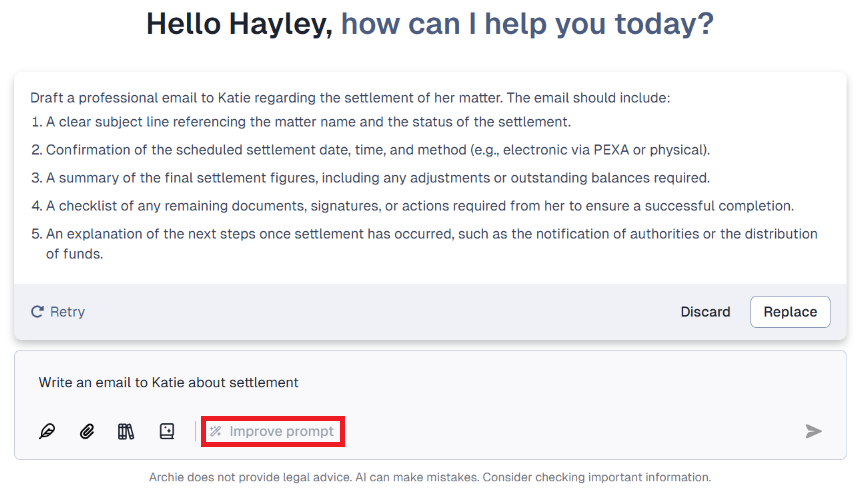
Expectations and limitations when asking Archie
- Once the Archie add-on has been enabled for your firm, triConvey will start training Archie on the last 50 matters the firm have worked on.
- When uploading a large number of documents to your matter, we suggest waiting before asking Archie questions to allow time for training.
- Refer to Archie file size limits for the maximum file sizes that Archie will ingest.
What Archie cannot do
- Provide accurate information regarding case law and legislation - use LawY for this.
- Extract information from deleted documents.
- Compare documents located in separate triConvey matters.
Advanced tips for creating your prompts
The tips below can come in handy, especially when creating reusable prompts for your Archie Prompt Library.
Creating a Prompt Input form to collect prerequisite information
There are many cases where matter information isn't explicitly stored in the matter, which means Archie will make assumptions about the situation when running the prompt. You can prevent this by giving Archie context with a Prompt Input form that collects the finer details before running the prompt.
Learn more about Prompt Input forms.
Guiding Archie with instructions
You can use the < and > symbols to tell Archie how to handle specific cases - for example, "<only include if client has an email>".
Archie can pick up on this and follow the conditional logic when executing your prompt, preventing it from making assumptions and helps it to produce cleaner, more accurate drafts.
Anything placed inside < > tells Archie:
- when something should appear,
- when something should be removed, or
- how something should change, depending on the information Archie has at drafting time.
Think of the symbols as “Only do this if it applies.”
Learn more about writing instructions for Archie.
Adding placeholders for dynamic details
Use [and ] to mark where information should be filled in by Archie - for example, [client last name]. It keeps your sample output flexible and reusable across different matters.
Learn more about using placeholders.
triConvey AI disclaimer
Like many AI software programs, Archie is a powerful tool that saves time and effort. However, while an answer may sound correct and read well, it may not be correct.
Archie is a matter assistant, not a legal assistant. Do not expect Archie to answer questions about legislation or case law in an accurate manner.
It is incredibly important to Trust, but verify. Always read responses from Archie carefully to ensure that they are accurate.
We recommend verifying Archie's responses by checking the links to supporting documents provided at the bottom of the responses.
Was this article helpful?
That’s Great!
Thank you for your feedback
Sorry! We couldn't be helpful
Thank you for your feedback
Feedback sent
We appreciate your effort and will try to fix the article